June 18, 2025 – New York
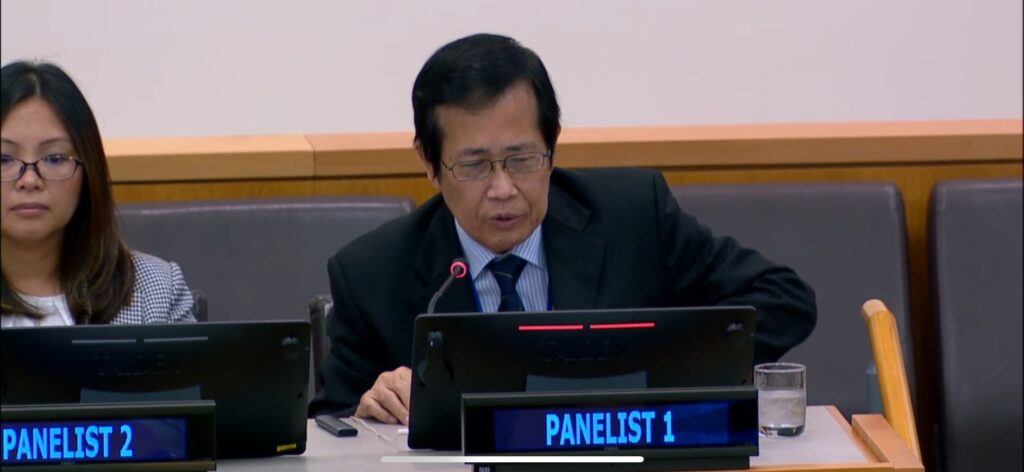
At the United Nations Headquarters in New York, Judge Kriangsak Kittichaisaree delivered a presentation during Segment 2 of the twenty-fifth meeting of the Open-ended Informal Consultative Process on Oceans and the Law of the Sea (ICP25). His remarks focused on the Practical Challenges in implementing Part XIV of the United Nations Convention on the Law of the Sea (UNCLOS), which addresses the development and transfer of marine technology (TMT).
Drawing upon his previous engagement with the ICP in 2011, Judge Kriangsak revisited persistent challenges in capacity building and technology transfer, emphasizing that the core impediment to effective TMT lies in the protection of intellectual property rights held by technology owners and suppliers. He noted that while Part XIV of UNCLOS lays out general obligations regarding TMT, the implementation remains constrained by legal and commercial realities.
He referenced the Intergovernmental Oceanographic Commission (IOC)’s Criteria and Guidelines on the Transfer of Marine Technology, which seek to balance the legitimate interests of technology holders with the broader goal of international cooperation. The IOC plays a pivotal role as a clearinghouse mechanism connecting parties interested in TMT.
Judge Kriangsak also offered a comparative analysis between two major conceptual approaches to TMT: the rights-based approach and the needs-based approach. The rights-based approach emphasizes the entitlement of States—particularly developing ones—to receive marine technology through multilateral frameworks such as the Biodiversity Beyond National Jurisdiction (BBNJ) Agreement, which includes dedicated provisions on capacity building and TMT (Part V). He also cited practical examples, such as bilateral joint ventures where foreign entities gain access to coastal waters in exchange for technology sharing.
In contrast, the needs-based approach places the responsibility on recipient States to assess their technological needs, identify appropriate and sustainable technologies, and ensure long-term viability. With many international organizations facing financial constraints, Judge Kriangsak advocated for increased regional cooperation and pooled investments in infrastructure and hardware. He also encouraged developed States to earmark official development assistance (ODA) specifically for TMT and capacity building in developing countries.
He concluded by linking these approaches to contemporary legal developments, highlighting the recent Advisory Opinion on Climate Change and International Law by the International Tribunal for the Law of the Sea (ITLOS), which reinforces the obligation of developed States under Article 202 of UNCLOS to assist developing States in establishing programs to combat marine pollution, including from greenhouse gas emissions.
Judge Kriangsak’s presentation reinforced the importance of institutional coordination and innovative funding strategies to address the evolving challenges in marine technology transfer under international law.